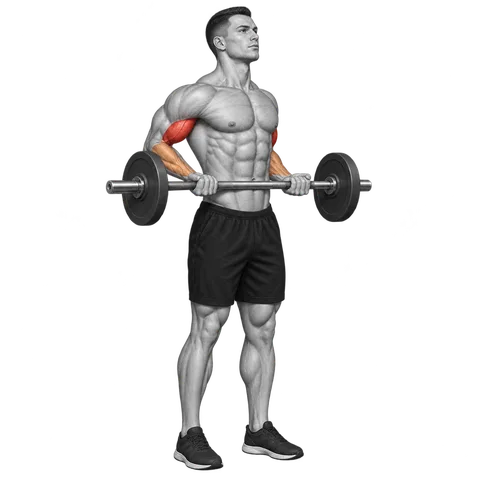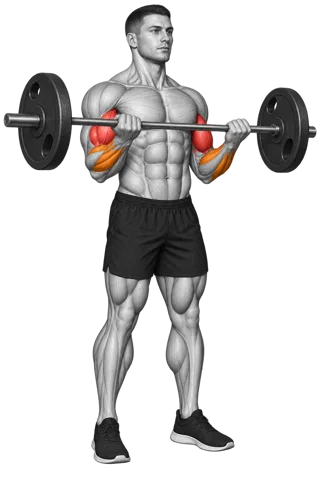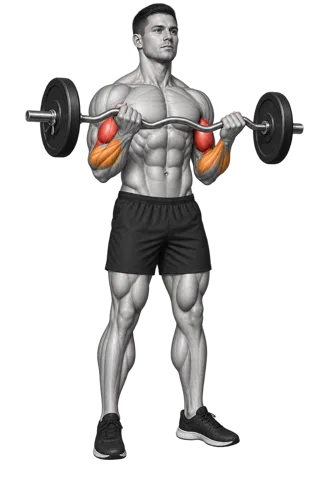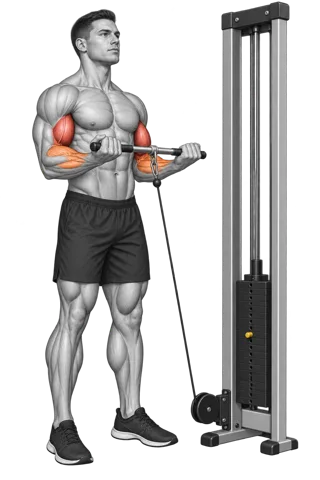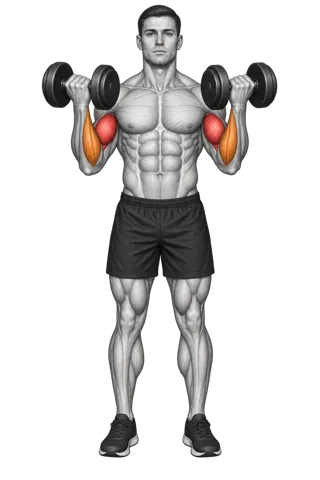
How to do the bicep curl (dumbbell)
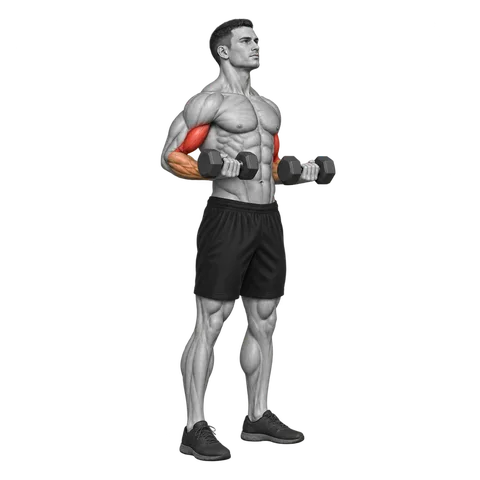
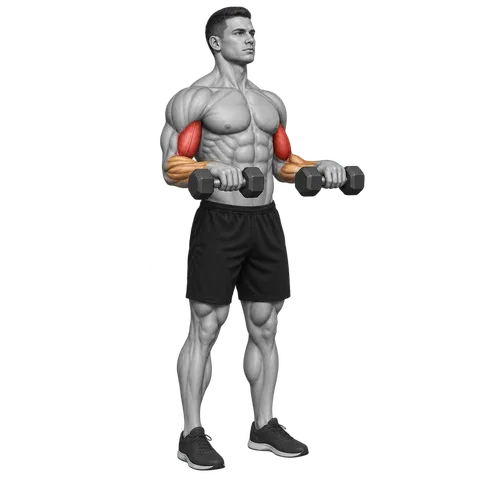
The dumbbell curl is a standing curl with a dumbbell in each hand. It trains the biceps, with the forearms helping. It suits beginners and lets each arm work on its own.
Setup
- Pick a pair of dumbbells you can curl with strict form.
- Stand tall with your feet about hip width apart.
- Let the dumbbells hang at your sides with your palms facing forward.
- Keep your elbows close to your sides.
One rep
- Brace your core and keep your chest up.
- Curl the dumbbells up by bending your elbows.
- Keep your upper arms still as the weights rise.
- Squeeze your biceps at the top for a moment.
- Lower the dumbbells under control to straight arms.
Common mistakes
- Swinging the torso uses momentum, so stand still and pick lighter dumbbells.
- Letting the elbows drift forward moves load to the shoulders, so keep them at your sides.
- Stopping short at the bottom cuts the range, so straighten your arms fully between reps.
- Rushing the lowering part wastes half the rep, so lower in two to three seconds.
Tips
- Breathe out as you curl and breathe in as you lower.
- Curl both arms together or one at a time. Keep the same choice for all your sets.
- Choose a weight that lets you finish every rep without leaning back.
Sets and reps
Do 3 sets of 8 to 15 reps. Place it after your main back or pull lifts.
Muscles worked
The main muscle is the biceps. It also trains the forearms. In FORCE, each set you log counts toward the recovery of the main muscle, and a share counts toward the helper muscles.
How FORCE coaches the bicep curl (dumbbell)
- Next-set weight. Log the weight, the reps and the reps you had left. FORCE gives the weight for your next set. How the coach works
- Recovery. Your sets update the ready time of the biceps. Recovery in FORCE
- Warm-ups. FORCE plans warm-up sets from your working weight.
- Swaps. If a helper muscle is not ready, the coach suggests another exercise for the biceps.