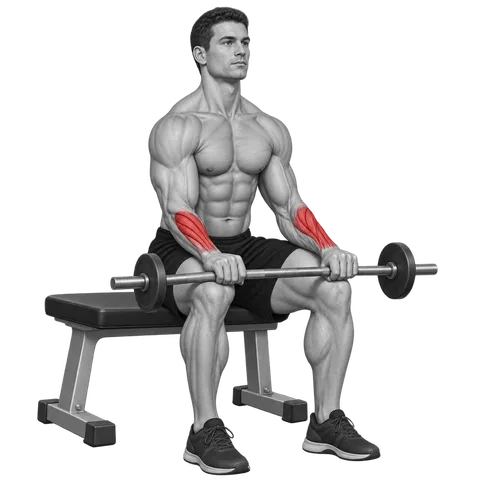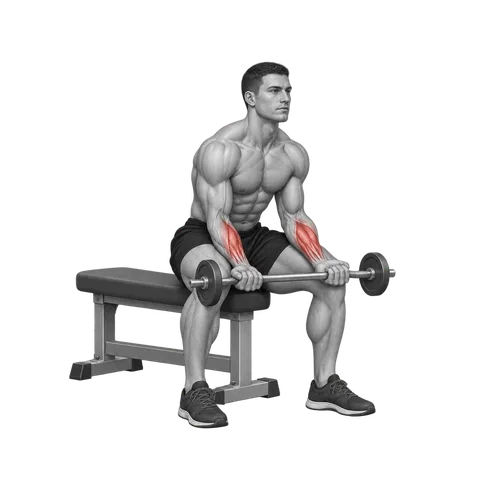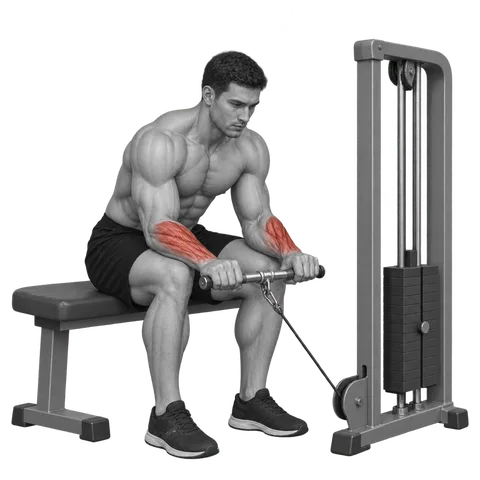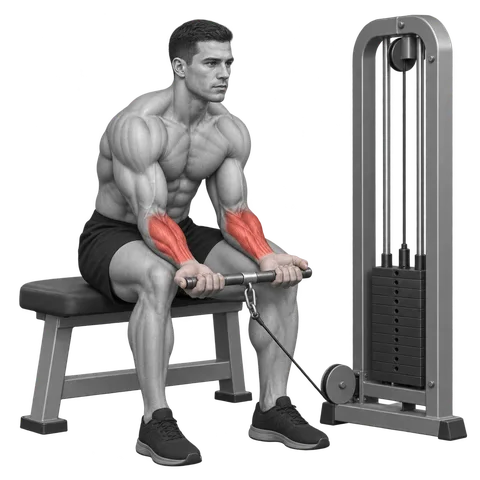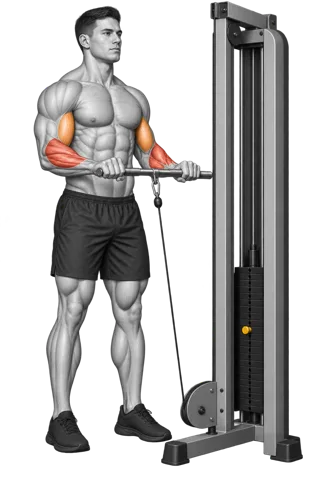
How to do the cable reverse grip curl
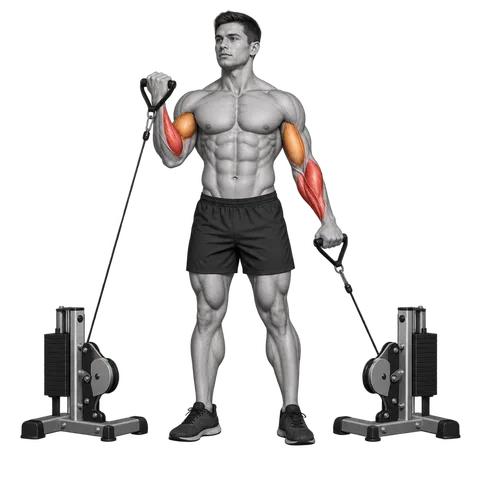
The cable reverse grip curl is a standing curl at a low pulley with your palms facing down. It trains the forearms, with the biceps helping. It suits intermediate lifters who want direct forearm work.
Setup
- Set the pulley at the lowest position and attach a straight bar or an EZ bar.
- Grip the bar overhand at about shoulder width.
- Stand close to the stack with your arms straight.
- Keep your elbows at your sides and your wrists straight.
One rep
- Brace your core and keep your chest up.
- Curl the bar up by bending your elbows.
- Keep your palms facing down and your wrists in line with your forearms.
- Squeeze your forearms at the top for a moment.
- Lower the bar under control to straight arms.
Common mistakes
- Letting the wrists bend down at the top loses the forearm work, so keep your wrists straight.
- Swinging the torso uses momentum, so stand still and lower the weight.
- Letting the elbows drift forward moves load to the shoulders, so keep them at your sides.
- Using a curl weight is too heavy for this grip, so start with less than you use on a normal curl.
Tips
- Breathe out as you curl and breathe in as you lower.
- Take two to three seconds on the way down.
- Use an EZ bar if the straight bar strains your wrists.
Sets and reps
Do 3 sets of 10 to 15 reps. Place it at the end of an arm or pull workout.
Muscles worked
The main muscle is the forearms. It also trains the biceps. In FORCE, each set you log counts toward the recovery of the main muscle, and a share counts toward the helper muscles.
How FORCE coaches the cable reverse grip curl
- Next-set weight. Log the weight, the reps and the reps you had left. FORCE gives the weight for your next set. How the coach works
- Recovery. Your sets update the ready time of the forearms. Recovery in FORCE
- Warm-ups. FORCE plans warm-up sets from your working weight.
- Swaps. If a helper muscle is not ready, the coach suggests another exercise for the forearms.