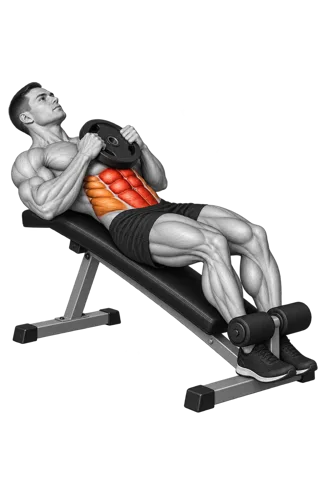
How to do the decline weighted sit-up
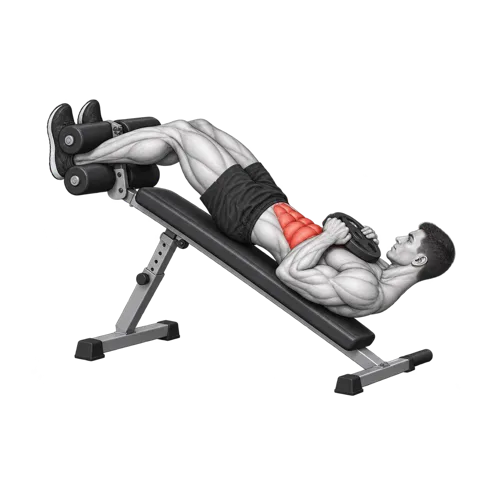
The decline weighted sit-up is a sit-up on a decline bench while you hold a plate at your chest. It trains the abs, with the obliques helping. It suits intermediate lifters who can already do bodyweight decline sit-ups with control.
Setup
- Set the decline bench to an angle you can control.
- Lock your feet under the rollers.
- Sit on the bench and hold a weight plate flat against your chest.
- Brace your abs before you start.
One rep
- Lower your torso under control toward the bench.
- Stop just before your back rests flat on the bench.
- Curl your ribs toward your pelvis to start the sit-up.
- Sit up until your torso is upright.
- Pause, then lower again under control.
Common mistakes
- Yanking with your neck strains it, so keep your chin neutral and lead with your chest.
- Letting the plate slide or drift away makes the rep harder to control, so hold it tight against your chest.
- Dropping fast to the bench removes tension, so lower in two to three seconds.
- Using too steep an angle makes the reps sloppy, so lower the angle until you control every rep.
Tips
- Breathe out as you sit up and breathe in as you lower.
- Add load in small steps, from a 2.5 kg or 5 lb plate up.
- Hold the plate higher on your chest to make the rep harder.
Sets and reps
Do 3 sets of 8 to 15 reps. Place it near the end of a workout.
Muscles worked
The main muscle is the abs. It also trains the obliques. In FORCE, each set you log counts toward the recovery of the main muscle, and a share counts toward the helper muscles.
How FORCE coaches the decline weighted sit-up
- Next-set weight. Log the weight, the reps and the reps you had left. FORCE gives the weight for your next set. How the coach works
- Recovery. Your sets update the ready time of the abs. Recovery in FORCE
- Warm-ups. FORCE plans warm-up sets from your working weight.
- Swaps. If a helper muscle is not ready, the coach suggests another exercise for the abs.