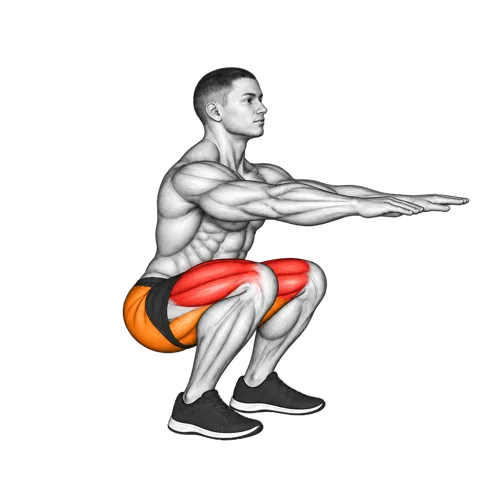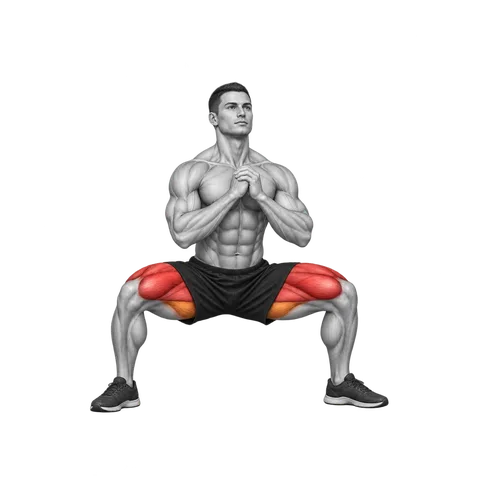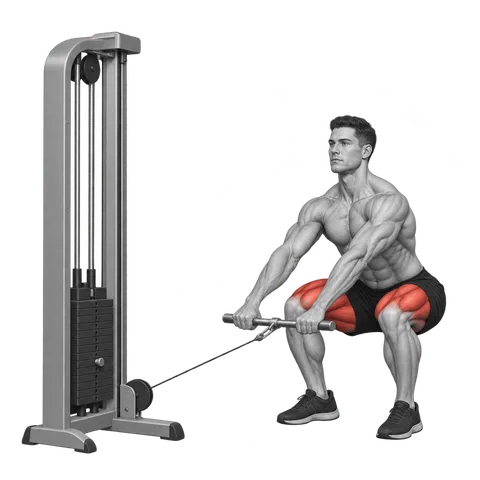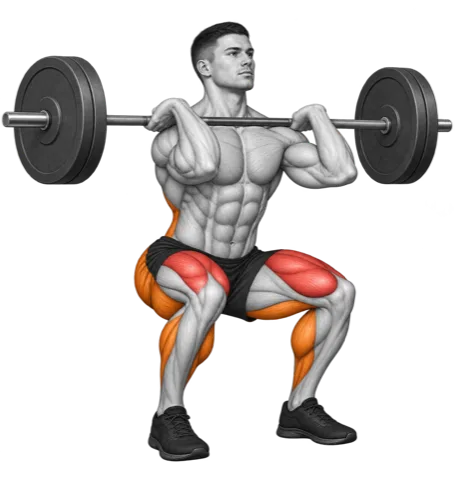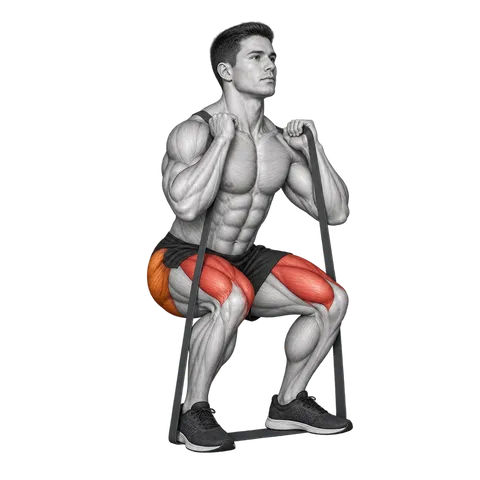
How to do the resistance band squat
The resistance band squat is a squat where you stand on a band and hold its ends at your shoulders. It trains the quads, with the glutes helping, and the band gets harder as you stand up. It suits beginners and lifters who train at home.
Setup
- Check the band for tears or worn spots before use.
- Stand on the middle of the band with your feet about shoulder width apart.
- Turn your toes out slightly.
- Bring the band ends up to your shoulders with your palms facing forward or in.
One rep
- Brace your stomach and keep your chest up.
- Bend your knees and hips to sit down between your hips.
- Keep your heels down and your knees in line with your toes.
- Go as low as you can with a flat back.
- Push through your whole foot to stand tall.
Common mistakes
- Letting the heels lift, so keep your weight over the middle of your foot.
- Letting the knees cave in, so push them out in line with your toes.
- Dropping the hands from the shoulders, so keep the band ends fixed at your shoulders.
- Leaning far forward, so keep your chest up and sit down between your hips.
Tips
- Breathe in as you squat down and breathe out as you stand.
- Pause for one second at the bottom to make the set harder.
- Use a thicker band or a wider stance on the band to add tension.
Sets and reps
Do 3 sets of 15 to 20 reps. Use it as the main leg exercise in a home workout or as a warm-up before barbell squats.
Muscles worked
The main muscle is the quads. It also trains the glutes. In FORCE, each set you log counts toward the recovery of the main muscle, and a share counts toward the helper muscles.
How FORCE coaches the resistance band squat
- Next-set weight. Log the weight, the reps and the reps you had left. FORCE gives the weight for your next set. How the coach works
- Recovery. Your sets update the ready time of the quads. Recovery in FORCE
- Warm-ups. FORCE plans warm-up sets from your working weight.
- Swaps. If a helper muscle is not ready, the coach suggests another exercise for the quads.