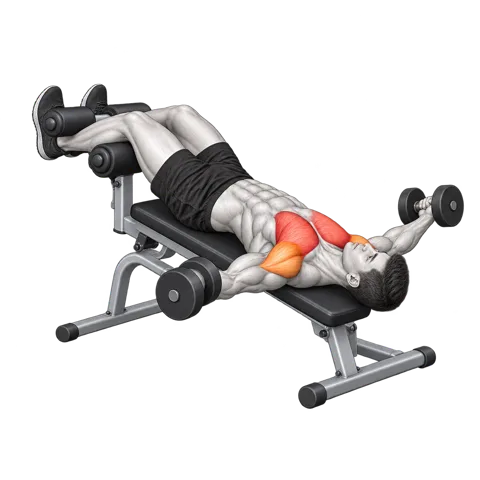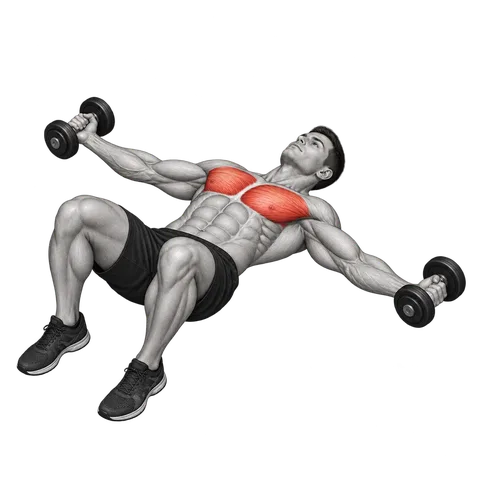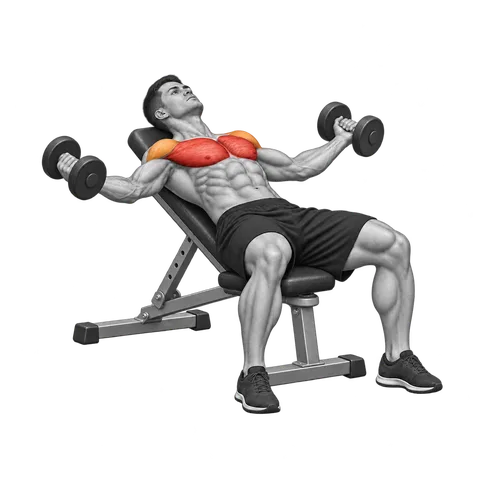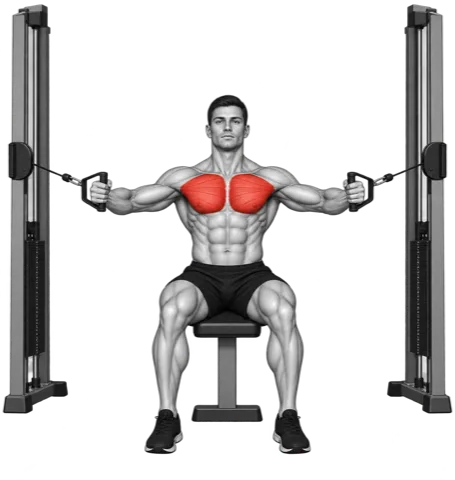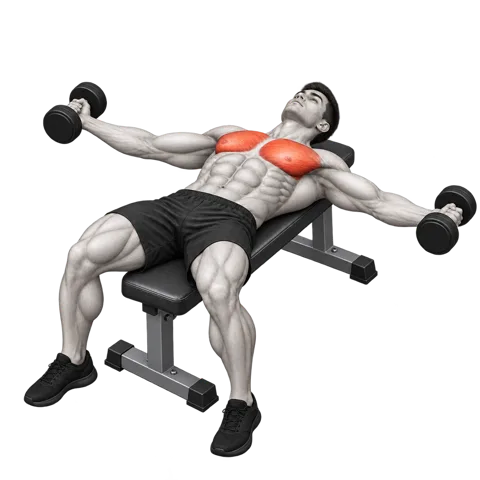
How to do the dumbbell chest fly
The dumbbell chest fly is a flat bench movement where you open your arms wide and bring the dumbbells back together over your chest. It trains the chest. It suits beginners and needs only a bench and a pair of dumbbells.
Setup
- Sit on a flat bench with a dumbbell on each thigh.
- Lie back and press the dumbbells up over your chest.
- Turn your palms to face each other.
- Bend your elbows a little and keep them in that position.
- Plant your feet flat on the floor.
One rep
- Open your arms in a wide arc until you feel a stretch in your chest.
- Keep the same slight bend in your elbows.
- Stop when your upper arms are about level with your body.
- Bring the dumbbells back up in the same arc.
- Stop just before the dumbbells touch at the top.
Common mistakes
- Bending the elbows more on the way down turns the fly into a press, so keep the elbow angle the same.
- Going too low strains the front of the shoulder, so stop when your upper arms reach body level.
- Using too much weight shortens the range, so pick a load you can control through the full arc.
- Dropping into the stretch is hard on the shoulders, so lower the dumbbells for two to three seconds.
Tips
- Think of hugging a large barrel.
- Keep your shoulder blades back and down on the bench.
- Press the dumbbells to your thighs and sit up with them to end the set safely.
Sets and reps
Do 3 sets of 10 to 15 reps. Place it after your presses.
Muscles worked
The main muscle is the chest. In FORCE, each set you log counts toward the recovery of the main muscle, and a share counts toward the helper muscles.
How FORCE coaches the dumbbell chest fly
- Next-set weight. Log the weight, the reps and the reps you had left. FORCE gives the weight for your next set. How the coach works
- Recovery. Your sets update the ready time of the chest. Recovery in FORCE
- Warm-ups. FORCE plans warm-up sets from your working weight.
- Swaps. If a helper muscle is not ready, the coach suggests another exercise for the chest.