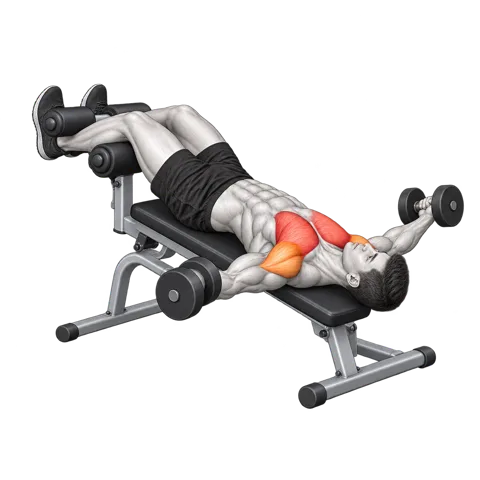
How to do the dumbbell decline fly
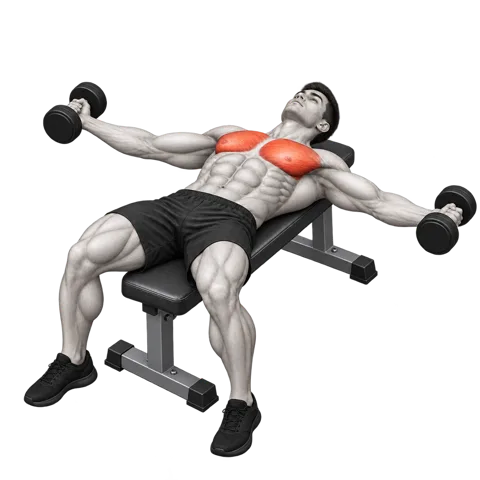
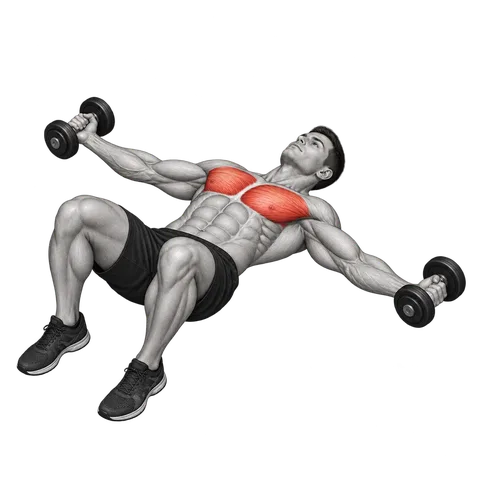
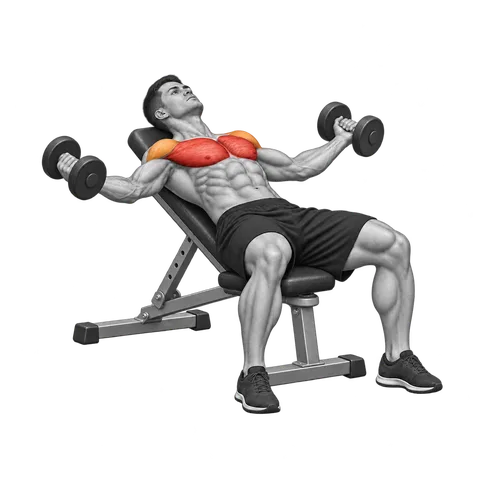
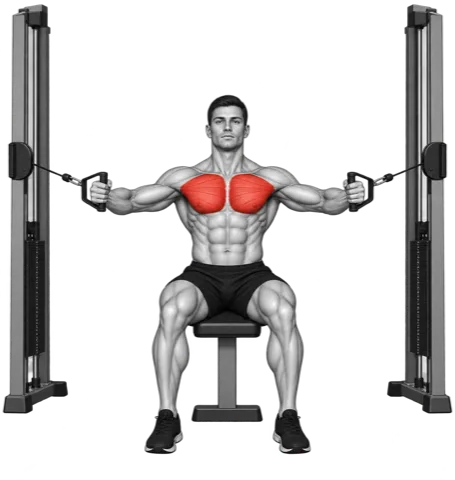
The dumbbell decline fly is a fly on a decline bench, with your head lower than your hips. It trains the chest, with the front delts helping. The angle moves the work toward the lower chest.
Setup
- Set a decline bench to a low angle and hook your feet under the pad.
- Rest a dumbbell on each thigh and lie back with care.
- Press the dumbbells up over your chest.
- Turn your palms to face each other and bend your elbows a little.
One rep
- Open your arms in a wide arc.
- Keep the same slight bend in your elbows.
- Stop when the dumbbells are about level with your chest.
- Bring the dumbbells back up in the same arc.
- Stop just before the dumbbells touch at the top.
Common mistakes
- Going too low strains the front of the shoulder, so stop when the dumbbells reach chest level.
- Bending the elbows more on the way down turns the fly into a press, so keep the elbow angle the same.
- Setting the bench too steep makes the blood rush to your head, so use a low angle.
- Using weights you cannot control makes it hard to get off the bench, so start light.
Tips
- Ask a spotter to hand you the dumbbells if they are heavy.
- Sit up slowly at the end of the set, so you do not feel dizzy.
- Keep your shoulder blades back on the bench through the whole rep.
Sets and reps
Do 3 sets of 10 to 15 reps. Place it after your presses.
Muscles worked
The main muscle is the chest. It also trains the front delts. In FORCE, each set you log counts toward the recovery of the main muscle, and a share counts toward the helper muscles.
How FORCE coaches the dumbbell decline fly
- Next-set weight. Log the weight, the reps and the reps you had left. FORCE gives the weight for your next set. How the coach works
- Recovery. Your sets update the ready time of the chest. Recovery in FORCE
- Warm-ups. FORCE plans warm-up sets from your working weight.
- Swaps. If a helper muscle is not ready, the coach suggests another exercise for the chest.